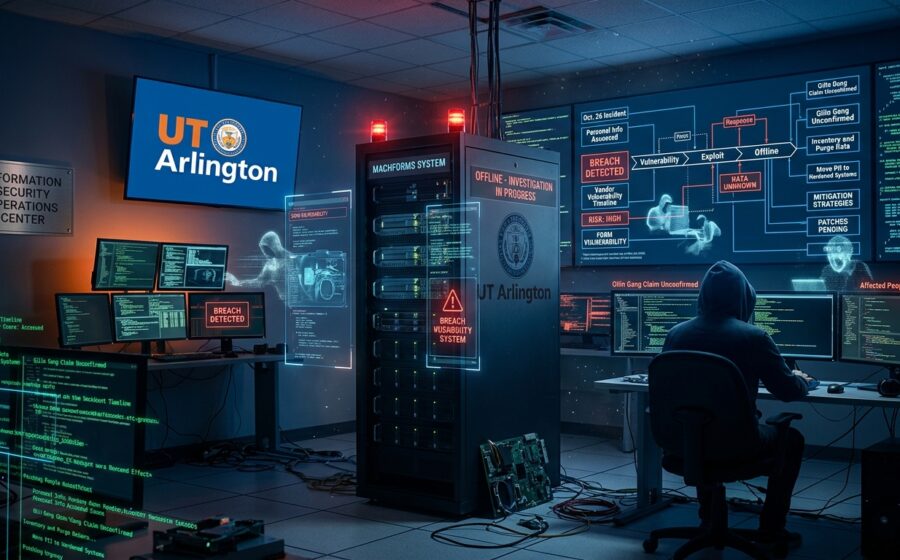
UT Arlington took its MachForms system offline on Oct. 27. That’s the tool the university used for event registrations, prospective student inquiries, service requests and surveys, according to The Shorthorn. On Nov. 13 a university spokesperson told The Record that the investigation confirmed personal information was stolen. UTA’s own update from Acting President Archie Holmes Jr. that same day uses a softer word: “accessed.” The university says it found the incident Oct. 26, still doesn’t know whose information or what kind, and will contact affected people directly. MachForms is still down.
Nobody treats the event sign-up form as a crown jewel, which is exactly why it sits on a server for seven years collecting names, phone numbers and whatever else somebody added to the form in 2019. On a plan review a couple of years back I asked a district IT director for a list of every system holding student PII. The list had the SIS, the LMS and payroll. It didn’t have the three survey tools the counseling office had set up on its own, one of them still taking submissions from a form nobody had looked at since COVID.
Why popular form builders draw attackers
The use of third party, well documented apps is a high risk. That’s my position and I’ll stand on it, with one tightening the evidence forces: the risk is highest when the app faces the internet and is holding PII. NIST and CIS don’t call third-party software high risk by default. They treat it as an asset and supplier risk you have to inventory and manage (CIS Control 3). The documentation part is where it gets real.
MachForm’s maker, Appnitro, released version 31 on Oct. 29 with fixes for three flaws, and its own release note says the CVE records were published in September, before a fixed version was available (Appnitro). The worst one, CVE-2026-78839, is a file-upload flaw rated 8.1 that can lead to code execution (CVE summary). Appnitro says none of the three can be exploited in a default install, and the upload bug needs a form set to accept .phar files. Then there’s the older stuff. A 2018 MachForm write-up on Exploit-DB includes ready-made Google search strings for finding MachForm forms on the open internet. And York University in Toronto said in September 2025 that a MachForm file-upload weakness was exploited to load files onto its servers, after which it put its public forms behind a campus login (York University).
No source ties those flaws to UTA, and UTA hasn’t said MachForms was the way in. I’m not saying it was either. But if you run MachForm anywhere in Texas, the vendor’s own timeline gave attackers a head start of weeks.
The Qilin ransomware gang has claimed the attack on its leak site, per The Record. That’s minimal sources. Nobody reputable has published what Qilin says it took, and UTA hasn’t confirmed the attribution.
MOVEit, Oracle and the mass-exploitation pattern
The reliance on all of these mainstream apps means that zero days affect everyone at the same time. MOVEit is the case that proves it. Cl0p started exploiting a SQL injection flaw in Progress Software’s MOVEit Transfer around May 27, 2023, and Progress had a patch out May 31 (BankInfoSecurity). Four days. By the end of that August, Emsisoft counted more than 1,000 organizations and about 60 million people hit (Security Affairs). The CISA and FBI advisory is still worth reading. Cl0p did it again in 2025 with Oracle E-Business Suite, and Google’s threat team put that one at more than 100 organizations, Harvard among them (CPO Magazine).
Think about that from an EOC. A hurricane at least gives you a cone. A mass exploitation campaign is every county landfalling the same week, and your mutual aid partners are fighting the same fire with the same vendor on the phone. That’s why I keep telling people to build the network before the incident. If you don’t already know the IT director two counties over, or the folks at your InfraGard chapter, May 31 is a bad day to start.
I tested this position and it holds for the software an attacker can scan for: file transfer tools, forms, VPNs, firewalls. Google found that 48% of the zero-days it tracked in 2025 targeted enterprise technology, a record (Google Threat Intelligence). It doesn’t hold for every zero-day. Plenty get burned quietly on a handful of targets, especially the mobile and browser chains spyware vendors sell (Security Affairs). And “the same time” applies to the break-in, not the bad news. MOVEit victims were still coming forward months later.
Moving PII out of third-party form tools
It’s important to move your collected data from those systems into hardened systems and remove the stored PII. This is the part of my argument the standards back the hardest. NIST SP 800-122 tells organizations to keep the use, collection and retention of PII to what is strictly necessary for the mission (NIST). NIST SP 800-53 covers the same ground in SI-12, with enhancements for limiting PII elements and disposing of information (SI-12). CIS puts “Enforce Data Retention,” with both a minimum and a maximum timeline, in Implementation Group 1, the starter set every organization is expected to do (CIS Control 3).
What that looks like on a Monday:
- Inventory every form, survey and sign-up tool on your network, including the ones a department stood up without IT. Who owns it, is it internet-facing, what fields does it collect, and how far back do the submissions go.
- Export submissions into your system of record on a schedule. The forms tool is the front door, not the filing cabinet.
- Purge from the forms tool after export. If it isn’t there, it can’t be stolen from there.
- Cut fields you don’t need. Nobody needs a date of birth to RSVP for a tailgate.
- Patch it, and put anything that doesn’t have to be public behind single sign-on, the way York did.
Two honest limits. Texas public entities can’t just delete records; they have to follow their approved records retention schedules, so “remove” means move to the records system and dispose of it on schedule. And hardened doesn’t mean immune. Security and networking products accounted for 21 of the 43 enterprise zero-days Google tracked in 2025 (Infosecurity Magazine). Moving the data shrinks how many places it can leak from. Collecting less is what actually lowers the stakes.
Some schools have already walked away from the tool. UNT Health Science Center in Fort Worth told form owners to move off MachForms in 2020 (UNTHSC), and the University of North Georgia decommissioned it this past summer, saying it took too many resources to keep secure (UNG).
If you filled out a UTA form, don’t assume you’re affected. Watch for a direct notice from the university, keep an eye on your accounts, and treat any email offering a “replacement form” or breach update as phishing until proven otherwise. A credit freeze is cheap insurance if you’re worried. Suspicious email goes to the UTA Information Security Office at [email protected].
Texas reporting clocks: 48 hours, 30 days, 60 days
A public university in Texas has to report a qualifying security incident to Texas Cyber Command within 48 hours of discovery, through the SPECTRIM portal (Texas Cyber Command). UTA hasn’t said whether it did. The breach notification law runs on a different trigger. Once an organization determines a breach involved sensitive personal information, it has 60 days to notify the people affected and, if 250 or more Texans are involved, 30 days to notify the Attorney General (Davis Wright Tremaine summary). “Sensitive personal information” is narrower than “personal information” — think a name plus a Social Security number, a driver’s license number, financial account credentials or health information. As of Nov. 15 I found no UTA entry on the Attorney General’s public breach list, which isn’t a violation if UTA hasn’t made that determination yet. The 30-day clock from an Oct. 26 discovery would have run out Nov. 25 if discovery were the trigger. It isn’t. The trigger is determination, and UTA says it still doesn’t know what was taken.