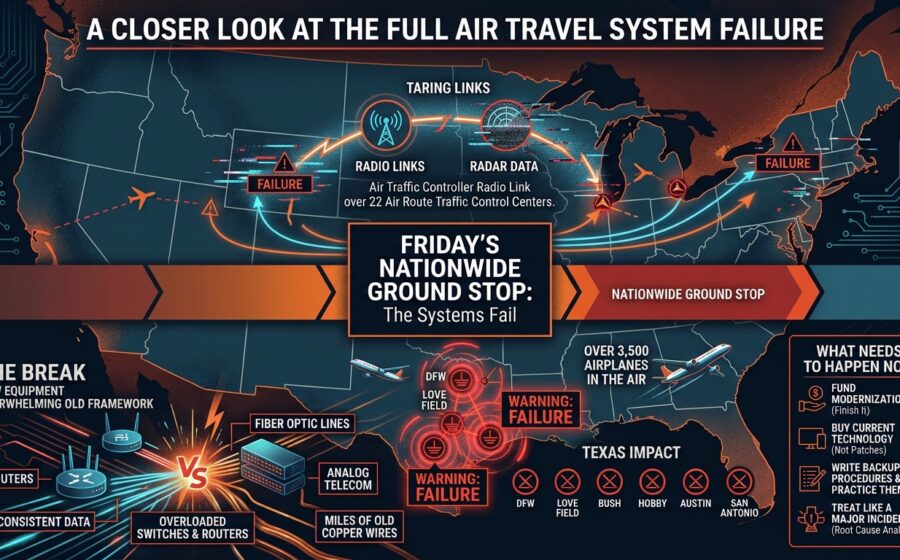
At 2:54 p.m. Central on Friday, the FAA’s Air Traffic Control System Command Center told every aircraft operator in the country to keep departures on the ground until further notice. DFW, Love Field, Bush Intercontinental, Hobby, Austin and San Antonio all stopped at the same moment. Duffy said there were over 3,500 airplanes in the air, and they kept flying to where they were going. The FAA lifted the stop at 01:15 UTC, which is 7:15 p.m. Central, a little more than four hours after it started.
I can’t imagine a full failure of the domestic air travel system, and Friday was the closest look at one I ever want to get. It was the first nationwide stop since the January 2023 NOTAM outage. That one involved preflight notices. This one hit the radio and radar links controllers use to work airplanes that are already flying, which is a different system and a bigger deal.
Timeline: how the FAA ground stop unfolded
All times Central.
- About 2:10 p.m. Before the national order, the FAA stopped flights bound for O’Hare, citing an equipment outage and communications issues. Midway got a matching stop.
- About 2:30 p.m. Duffy said “instability” in the radar communications at air traffic control centers began
- 2:54 p.m. The nationwide ground stop took effect.
- About 3:16 p.m. Duffy posted on X that the stop followed a communication issue affecting all Air Route Traffic Control Centers. Those centers are responsible for all flights above 18,000 feet, and there are 22 of them.
- 7:15 p.m. The stop was lifted. At a White House briefing afterward, Duffy and Homeland Security Secretary Markwayne Mullin laid out a preliminary cause.
What officials say broke
Duffy’s explanation was that switches and routers were overloaded and shut down when they began providing inconsistent data. He didn’t soften it. “What we have is an incredibly old air traffic control system,” he said, and he called it analog telecom. Mullin’s version was that the new equipment had overwhelmed the old framework. He called for a “complete overhaul” of FAA’s technology systems.
On cyber, Mullin said DHS had seen “zero evidence” of an attack, and that the stop wasn’t linked to this week’s Microsoft outage. When a reporter pressed him for certainty, he said, “There’s nothing completely certain right now,” then said, “It doesn’t appear that way.” I’ll take them at their word for tonight. An overloaded router passing bad data down the line is exactly the kind of plain, boring failure that old networks produce. But “doesn’t appear that way” is where a forensic review starts. I want the finished one in writing. Separately, Air Space Intelligence, the AI vendor behind the FAA’s new SMART system, said its software didn’t cause the ground stop.
Mullin’s point about new gear and old framework worries me more than the age of the equipment by itself. The FAA is in the middle of a big cutover. Miles of old copper wires have been replaced with fiber optic lines and old radio systems are gradually being replaced, and Friday looks like what happens when the two halves don’t agree with each other.
Texas impact: DFW, Love Field and the weekend
By Friday night, CBS Texas reported 591 delayed flights at DFW, down from over 800, and 526 canceled. The airport said it was still working with the FAA to land and deplane inbound flights. Fox 4 reported college football teams stranded ahead of Saturday games. Nationally, FlightAware counted 1,913 flights cancelled and 10,494 delayed at one point Friday evening.
Lifting the stop doesn’t put airplanes and crews back where they belong. Duffy warned that recovery is “going to be slow”, depending on how many crews are available. Expect it to take days for the domestic schedule to settle down.
What the federal government needs to do now
They’ve known for years that this system is old, so nobody should call Friday a surprise. Here’s what I want to see from Washington, and I don’t care which party gets the credit.
Fund the modernization and finish it. Congress approved $12.5 billion for the project last year. In 2025, DOT announced a plan to build a new air traffic control system by 2028 that would cost roughly $31.5 billion, and on Friday night Duffy asked for $50 billion. Argue about the number, then pay it. A country that can’t keep its own airspace open has a homeland security problem, and that goes well past airline delays.
Buy current technology, not patches. The Senate Commerce Committee noted that “no new” air traffic area control centers have been built “since Lyndon B. Johnson”. And the design has to make it impossible for one class of failure to reach all 22 centers at once. If an overloaded switch can freeze the whole country, the backup is on the same network as the primary, so it isn’t really a backup.
Write down the backup procedures and practice them. Friday’s backup plan was to stop everything. That kept people safe, and it’s still the worst option. The FAA needs a documented degraded-operations plan: what runs on what, who decides, and how traffic keeps moving at reduced capacity. It should be exercised with the airlines, the airports and the states, the same way we expect a county to exercise its COOP. We hold a county 911 center to a tested backup. The national airspace ought to meet the same bar.
Treat this like a major incident, because it was one. That means a public after-action report with the root cause, the timeline and the fixes, on a deadline. It means a finished cyber review that says what was checked. And state emergency management agencies, TDEM included, should be briefed on what happened and what to expect next time.
For Texas planners, the homework doesn’t change. A lot of our plans assume aircraft will be available: patient moves ahead of a hurricane, an IMT flying in, state resources staged by air. Pull your COOP and your hurricane annex, find every place they assume commercial air, and write down what you’d do if it stayed grounded for eight hours. Know your airport contacts before you need them. And check whether your own alternate communications path runs over the same carrier as your primary.
If your continuity plan assumes aircraft can still move people and supplies, what’s the backup when the national airspace is the single point of failure? As of Friday night, the FAA had a preliminary explanation but no published root cause.