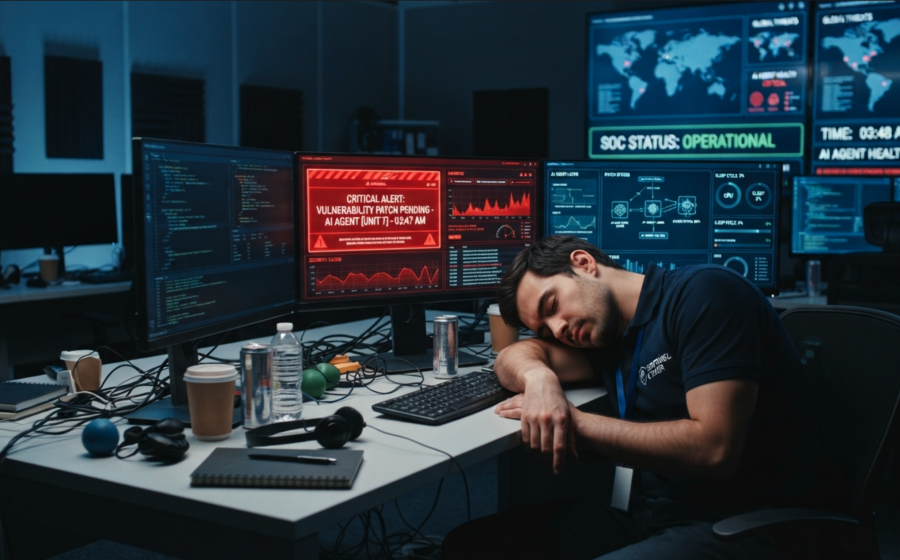
Fourteen minutes. That’s how long David Kennedy told CNN’s Erin Burnett it took to take apart one of his customers. More than 30 AI agents probed the company’s infrastructure at the same time. They logged in with valid usernames and passwords, found a flaw in how the company’s application handled two-factor authentication, pulled out a substantial amount of data and then encrypted the entire file system. Nobody at the company noticed for about four and a half hours, until systems started throwing errors and restarting on their own. It’s one responder’s account of an unnamed client, so call it minimal sources, and IBTimes notes it hasn’t been independently verified.
Then we had the week we just had. Is this part of a bigger problem, a crisis going on that’s not being disclosed? I’ve spent 25-plus years across emergency management, public safety and IT, and I can’t answer that. Neither can anyone outside a few rooms in Washington. What I can do is lay out what’s on the public record and where the holes are.
A week of US outages, and none of them were cyberattacks
The list, from The National Desk’s timeline and SiliconANGLE: Microsoft Exchange Online went down for nearly a day starting Nov. 12, leaving 450 million users without email. Microsoft blamed two software bugs, one of which had sat undetected for three months. On Nov. 13 the FAA ordered a nationwide ground stop, the third in its history, after technicians traced the trouble to a Juniper router at its El Dorado, Arkansas facility. More than 12,000 flights were cancelled. United had a tech outage on the 16th. Chase customers couldn’t get into their accounts on Monday, and the bank blamed a software bug in its hardware systems. Apple went down on the 17th after an internal update, Marriott’s sign-in broke the same day, Workday had problems, and NSANet, the network NSA uses for classified traffic, degraded during what officials called scheduled maintenance.
Every one of them said the same thing. Not a cyberattack. Homeland Security Secretary Markwayne Mullin told the House Homeland Security Committee on Nov. 18 he was “98 percent confident” the outages had nothing to do with adversaries going after our systems. FBI Deputy Director Christopher Raia said the bureau’s cyber teams had been on the investigations from day one and found no evidence of malicious activity.
I’ll take the FBI at its word on each of these. I’ve stood in enough SOCs (Security Operations Centers) to know a bad router or a botched update can do more damage in an afternoon than most hackers manage in a year. But if I stood in front of a city council and said I was 98 percent sure the water plant was fine, the first question would be about the other 2 percent, and they’d be right to ask it. There’s also a wrinkle nobody on TV is spending much time on: even the outages that weren’t attacks may trace back to the same AI that’s doing the attacking. SiliconANGLE reported that frontier AI models have turned up thousands of vulnerabilities in recent months, so administrators are patching more often with less time to prepare, which raises the odds of a human mistake taking a system down.
Europe is reporting massive cyber attacks. Why aren’t we?
Since Oct. 11, someone has been reaching into the refrigeration controllers in European grocery stores and changing the settings. Spain’s national CERT, INCIBE, logged a new wave the night of Nov. 1 into Nov. 2 that hit Ahold Delhaize, Carrefour, Colruyt, ICA, Coop and Musgrave stores in Belgium, Sweden, Luxembourg, Ireland, Estonia and other EU states. Freezers warmed up and the food went in the dumpster. Chatham House puts the October count in France at about 700 supermarkets running legacy temperature controllers that no longer get updates, and France has accused Iran.
Part of why we aren’t hearing the same thing here is that over there, somebody has to tell. The EU’s NIS2 directive requires critical sectors to report serious incidents, even though all but two member states missed the deadline to adopt it. Congress passed CIRCIA in 2022, which will require critical infrastructure to report covered incidents to CISA within 72 hours and ransom payments within 24. Four years later the final rule still isn’t out. I don’t think anybody’s hiding a war. I do think we’ve built a system where we wouldn’t necessarily know about one, and until that rule is in force, a company’s statement that it wasn’t a cyberattack is about the whole public record.
The other part is simpler. A grocery freezer that warms up on its own in five countries the same night doesn’t get explained as a capacity upgrade.
What our honeypot sensor is seeing
On our lab.txcyber.net sensor we are seeing over a thousand attacks an hour, mostly probing, but some are automated attempts to gain access to our honeypot. Appears to be probing for default passwords mostly, with some exploit attempts. This is sharply more active than just two weeks ago. We are not seeing any human element in any of the attacks. So the question is, are the bots getting better, or is there an agentic element now?
My read is both, and the line between them is getting hard to draw. A script that throws the same ten passwords at a million hosts is a bot. Something that tries a login, reads the error, changes its approach and comes right back is something else, and that’s what Kennedy described. Honeypots are where you see it first. Amazon’s MadPot honeypot recorded an exploit attempt against the PHP2Shell flaws on Oct. 17, four days before the bugs were made public.
The holes themselves aren’t new. Chatham House cites ENISA finding that two-thirds of exploited vulnerabilities already had a patch available, and the UK’s National Cyber Security Centre found no “novel class of attack” in the incidents it handled. Same holes we’ve been teaching about for years. What changed is the clock.
When do small IT and cyber teams sleep?
With the speed of these break-ins, I’m asking that for real. A two-person county IT shop doesn’t have a change window for any of this. Patches are coming out the same day and the vendors want them applied urgently. PHP shipped emergency fixes on Oct. 21 for two remote code execution bugs that affect every PHP install serving web requests, in versions 8.5.12, 8.4.27, 8.3.36 and 8.2.35, and a working exploit needs one unauthenticated request. NGINX had its own AI-found critical flaw this year, CVE-2026-42945, sitting in the rewrite module since a 2008 release.
So at this point, are we just to give up and rely on solid backups that are full backups, stored in various locations, for when our systems are compromised and potentially our data exfiltrated, then quickly restore from the last backup, patch quickly and move on in the cycle?
No. But backups are the floor, and a lot of shops are still below it. Look at Kennedy’s timeline again: the data left before the encryption started. A clean restore gets your systems running. It doesn’t pull your residents’ records off a leak site, and it doesn’t tell you whether whoever got in left themselves a way back.
Fourteen minutes against four and a half hours is a detection problem, so that’s where I’d spend the next dollar:
- Keep the full backups, offline or immutable, in more than one place, and time a real restore. If nobody’s restored the finance server since it was built, you don’t know how long it takes.
- Buy the overnight watch if you can’t staff it. A managed detection service or a regional shared arrangement covers the hours your two people are asleep.
- Anything internet-facing that can’t be patched within hours comes off the internet until it can. The European grocers that got hit disconnected their controllers, updated them or replaced them.
- Know what data you hold and who you’d have to notify before the extortion email shows up.
- Put the Texas Cyber Command in your phone. Local governments report through its Local Incident Reporting Form, school districts and charters use the same form under Texas Education Code 11.175, and the incident hotline is (877) 347-2476.
Has the agentic element changed how IT and cyber teams work from now on? Yes. The patch window used to be weeks and now it’s hours, and the human’s job is moving from doing the work to deciding what gets shut off at 2 a.m. That decision gets made in a tabletop, not in the middle of the incident, and the tabletops that go badly are usually the ones where nobody knew who had the authority to pull the plug. The call you make at 3 a.m. should be to someone who already knows your name, which means building the network now: InfraGard, TX-ISAO, the IT director in the next county over.
The White House cyber director is out
Sean Cairncross, national cyber director since August 2025, is leaving the post, a White House official confirmed Thursday. Axios framed it as a resignation timed so a successor can be confirmed before Democrats take Congress in January, while CBS and The Hill cited sources saying he was let go. Pentagon CIO Kirsten Davies is stepping in as acting director. Mullin also told Congress the administration would set up a call with the private sector about warning customers before big upgrades, while stressing that it isn’t pressuring industry to do it.