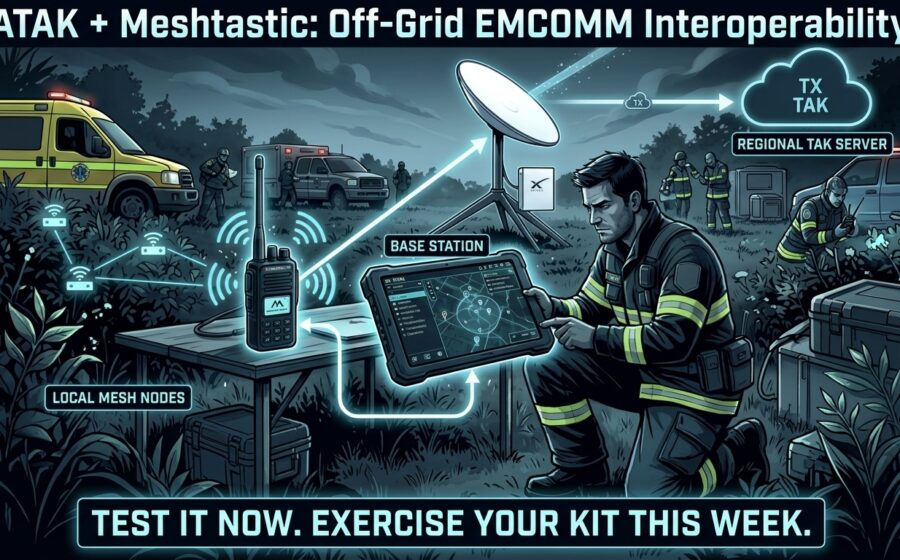
If you have a go-kit (ATAK & Meshtastic) made from a YouTube video that was created in the last few years, take it off the shelf this week and power it up. Chances are it won’t be working. Version 2.8.0 of the Meshtastic Android app removed the cross-process interface that the official ATAK plugin used to communicate with the radio. The project’s TAK Integration page now states that the old plugin cannot be used and advises against installing it. Interoperability occurs via a small TAK Server built into the Meshtastic App. Stock ATAK, iTAK or WinTAK running on the same phone will connect to this TAK Server.
However, the project’s own ATAK Plugin page continues to walk users through how to install the old plugin from GitHub.
While I believe this combination is excellent for Out of Band Communications and has potential applications for many Texas EMCOMM Plans, I am concerned about the fact that most of these kits have never been exercised.
What does ATAK over a LoRa mesh actually carry?
Meshtastic is open source firmware for inexpensive LoRa radios. Each radio pairs to a phone via Bluetooth and re-broadcasts anything it hears. Messages are passed from node to node without towers, internet or carriers. By default, a message will pass through three nodes before nodes stop passing it along. Most of this operates unlicensed in the 902-928 MHz band in the United States.
What passes across the mesh depends upon firmware. Radios running 2.7.x or older use V1 format which includes position (PLI) and GeoChat and nothing else. Shapes, markers, routes, etc., are dropped. Firmware 2.8.0 and newer uses V2, a compressed format that includes shapes, markers, routes, aircraft, CaseVac, emergency and task messages. If you have a mixed mesh, the old format will still pass through the network and therefore one stale radio won’t break the net; however, whatever that radio sends will be dots and chat.
Bandwidth is another aspect to discuss with elected officials prior to someone promising them a common operating picture. It is a text-and-dots pipe and if a vendor tells you it will pass drone video, ask them to demonstrate it in the field. The default LongFast preset operates at approximately 1 kbps. The fastest settings operate at approximately 21.88 kbps including overhead and Meshtastic core developer Thomas Göttgens stated during his FOSDEM 2025 presentation that the defaults are optimized for range and any local community past 30 to 40 nodes should modify their settings.
There are two device roles that matter here. A radio set to TAK is a full participant: CoT, chat and position. A radio set to TAK Tracker only beacons its location on a timer and doesn’t relay chat, making it ideal for a radio velcroed to a dashboard, generator or high-water vehicle. The callsign on the ATAK map comes from the radio’s node name.
Kerr County and where a mesh fits
Mesh radios would not have provided fixed public warning on the Guadalupe River and I don’t want anyone reading this to think they would. According to the Texas Newsroom, a volunteer firefighter requested dispatch to send a CodeRED alert at 4:22 AM on July 4, 2025, and dispatch said she needed authorization from a supervisor. Some residents didn’t receive their first alert until after 10 AM.
Additionally, according to the same story, cell service during the flood was spotty and worst in the county’s rural areas. The story quoted a 2016 Kerrville Daily Times article regarding limited cellphone and radio access in West Kerr County. That is the gap this tool is for. Responders who know where each other are when the phones go quiet. A handful of solar nodes placed and tested well before flood season on high ground with TAK Trackers in the trucks.
Setting up Meshtastic radios for a TAK team
Do this on a slow Wednesday with the people who will be carrying the radios, not the night before landfall.
- Wipe every radio and flash it yourself using 2.8.0 or newer firmware. More on why below.
- Make channel 0 private with a random 256-bit key. Do not use the default “LongFast” channel as your ATAK channel.
- Don’t worry about losing the public mesh. Nodes re-broadcast every packet that shares their modem settings, encrypted or not, so your traffic still rides the hobbyist nodes for range and they just can’t read it.
- Leave max hops at 3 unless you know exactly why you’re changing it.
- Keep public MQTT off on team radios. Meshtastic warns that connecting to the public MQTT server can publish the locations of every node in your mesh to the internet.
- Set phone-paired radios to TAK and vehicle radios to TAK Tracker. In the Meshtastic app, turn on the local TAK server (it listens only on the phone itself, port 8089, with mutual TLS), export the data package and import it into ATAK. The TAK module uses whatever channel encryption you set, which is why step 2 comes first.
Security homework
In June 2025 the Meshtastic project published GHSA-gq7v-jr8c-mfr7, tracked as CVE-2025-52464. Several hardware vendors’ flashing process had been loading duplicate public/private key pairs onto radios, and on some platforms the firmware wasn’t seeding its random number generator properly. Anyone who compiled the list of compromised keys could decrypt direct messages from an affected radio and in some cases impersonate a remote administrator. The project scored it 9.5, critical. This is the one that tells you everything about buying radios that come “pre-configured.” Firmware 2.6.11 fixed key generation and 2.6.12 wipes known bad keys automatically. The advisory’s workaround is a full device wipe with the Python CLI: meshtastic --factory-reset-device.
They’re network devices, so keep a firmware log for them the same way you would for a switch or a firewall. Don’t wait till the event/emergency to have your kit ready!
Many good EMCOMM people are ham radio operators and I wouldn’t put responder PLI from a search or a law enforcement operation on Meshtastic’s licensed mode. Run the team mesh unlicensed and encrypted and let the hams run theirs. Licensed mode allows up to 10 W depending on license class, but it turns off encryption entirely, direct messages included, won’t forward encrypted packets and broadcasts the operator’s callsign every ten minutes.
One from the radio shop
In one of my previous lives, communications rarely went down, but what broke during incidents was the stuff around it: a talkgroup nobody had programmed, a mutual-aid unit that showed up with radios we’d never seen. Every one of those was fixed by a phone call made months earlier to somebody we already knew. So many times were there regional wildland fires that brought agencies in from all over the region that had not worked together in a long time. They updated their radio models, used a third-party to program their radios that didn’t add in key interoperability channels. It really created real safety issues.
Getting your mesh onto Texas TAK
If your agency isn’t on Texas TAK yet, make that phone call before you buy a single radio. DPS already did the hard part. According to a 2023 TxICC presentation from DPS, TAK Manager went live in 2022, partners can sign in through LEEP, FirstNet or FTI and pull their own certificates and admins can issue temporary certificates to onboard mutual-aid partners fast. This is not based on Meshtastic and relies on cellular data/internet connections. A local mesh is still local, though. Whether your mesh picture ever reaches the state server depends on a gateway somewhere with a backhaul and that belongs in the comms plan, not in somebody’s head. Don’t forget resources like Starlink that can help gateway your local mesh network to upstream systems.
That same DPS deck has a slide on mobile ad hoc mesh networks for off-grid comms in remote areas, “easily integrated into TAK.” While the presentation has not had a revision since publishing, it is important to note that it did not note Meshtastic as a potential solution for EMCOMM, but it is worth your consideration today.